Every business mile claimed, your tax worked out for you
Driving for Amazon Flex, Uber Eats, Deliveroo, Just Eat or Evri? Whether you call yourself a delivery driver, a courier or a rider, Debbie logs your business miles at HMRC's rate, sorts your pay and costs from your bank statement and shows what you owe, worked out from your figures, so you can file your own tax return with confidence.
Self Assessment for delivery drivers in three steps
What you actually do in Debbie, shown on real screens from the app.
-
1
Upload your bank statement
Export a statement from your banking app as a PDF, CSV, OFX or QIF and drop it into Debbie. It spots your Uber, Deliveroo, Amazon Flex, Just Eat and DoorDash payments and books them as driver income, then asks you about anything it is not sure of.
Parking, phone and kit come through as costs. Snap a receipt for anything that is not on the statement.
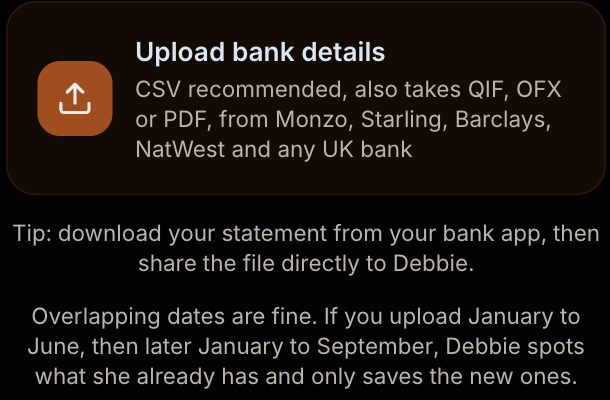
A real screen from the app. -
2
Tap your start and end odometer
Leaving the depot? Pop in your odometer reading. Done your last drop? Pop in the reading again and tap submit. Debbie works out the business miles you drove that day and claims them at HMRC's rate. No logging every drop-off.
Already use Driversnote or another mileage app? Upload its Excel or CSV export and Debbie adds your business trips only. Personal trips are left out.
The Mileage screen shows how much of the 10,000 mile band you have used this tax year.
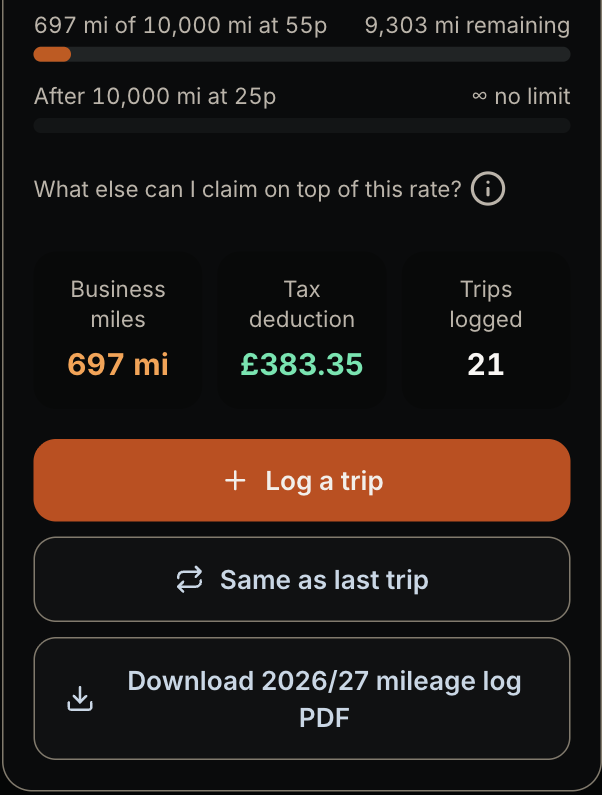
A real driver's screen from the 2026/27 tax year, at 55p a mile. -
3
See your Tax Return page
Your money in, costs and miles come together as one profit figure, the figure you pay tax on, with your tax estimate underneath. Download your Tax Return Pack to file it yourself or hand it to whoever files for you.
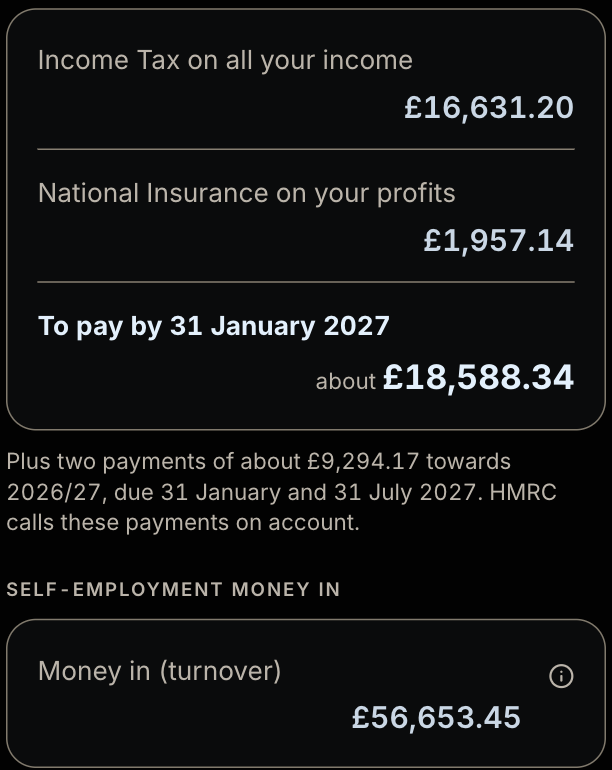
A real screen from a test account, 2025/26 tax year.
HMRC's mileage rate for 2026/27: 55p a mile
From 6 April 2026 a car or van claims 55p a mile for the first 10,000 business miles in the tax year, then 25p. Before that date it was 45p, which is why you still see 45p quoted. GOV.UK: simplified expenses for vehicles.
That 10,000 is one band per business each tax year, shared by all its cars and vans. A motorcycle, moped or scooter claims 24p a mile with no threshold. A bicycle or e-bike goes on real costs instead, HMRC's flat rate doesn't cover bikes for the self-employed, so you claim what the bike actually costs you, split by business use from your logged miles. If your bike costs for the year are small, the £1,000 trading allowance may be the bigger deduction. You claim one or the other, never both. Debbie uses the bigger one.
Home to the depot and your last drop back home count as commuting, so HMRC doesn't allow those miles. GOV.UK: travel expenses if you're self-employed.
A worked example, in HMRC's maths
HMRC lets you take 55p a mile off your profit for your first 10,000 business miles and 25p after that. A driver doing about 25 hours a week across apps could log about 11,500 miles and pay £0 Income Tax and £0 Class 4 NI.
Example for 2026/27: about £16,100 a year at £14 an hour over 46 weeks, with no other income. The miles take £5,875 off profit (10,000 at 55p plus 1,500 at 25p) and phone, bag, phone holder and parking about £220 more. That leaves a profit of about £10,005, under the £12,570 Personal Allowance. Without the mileage claim they would pay about £860. A job or pension changes this.
Part time, 2 Amazon Flex blocks a week: about 3,000 business miles take about £1,670 off profit. With no other income the profit is already under £12,570, so the tax is £0 either way. With a job using the allowance the claim could save about £330.
Full time, 40 hours a week across apps: about 17,800 business miles take about £7,440 off profit. They could pay about £1,800 Income Tax and Class 4 NI instead of about £3,730 without the claim.
The mileage claim covers fuel, insurance, repairs and wear on the vehicle, so you do not claim those as well. Debbie keeps them out of your claim for you and asks when it cannot tell. Parking and tolls on the job can still be claimed. Fines never can. Past about 30 hours a week the 25 hour driver above would start paying tax.
Sources: GOV.UK: simplified expenses for vehicles and GOV.UK: Income Tax rates and GOV.UK: self-employed National Insurance rates.
Try it with your own hours, app and car.
Work out your tax with the free driver calculator →One Solo business covers every app
Drive for Uber, Deliveroo, Amazon Flex, Just Eat or DoorDash, perhaps a few of them at once? Debbie books those payments as your driver income, all under one business, because delivering for several apps is normally one trade.
Making Tax Digital: is it turnover or profit?
Turnover. Making Tax Digital for Income Tax looks at your takings before costs, not your profit after the mileage claim. Add up the money in from all your self employment together with any property income. Wages from a job, pensions, savings interest and dividends do not count. HMRC takes the figure from your Self Assessment return for that tax year.
| Your takings in | Over | You need it from |
|---|---|---|
| 2024 to 2025 | £50,000 | 6 April 2026 |
| 2025 to 2026 | £30,000 | 6 April 2027 |
| 2026 to 2027 | £20,000 | 6 April 2028 |
A driver can be over the line on takings while their profit is well under it.
Full time on Uber rides, takings of about £35,000 to £45,000 a year are over £30,000. Amazon Flex plus Uber Eats at about 40 hours a week could be close to £30,000 in takings, even though the mileage claim brings the profit down to about £19,500. A driver doing about 25 hours a week takes about £16,100, so nothing changes for them yet.
HMRC writes to tell you when you need to start. If you think you are over the line and no letter has come, you can check on GOV.UK.
Sources: GOV.UK: find out if and when you need Making Tax Digital for Income Tax and GOV.UK: work out your qualifying income.
-
Until then keep logging your miles and receipts and download your Tax Return Pack as you do now.
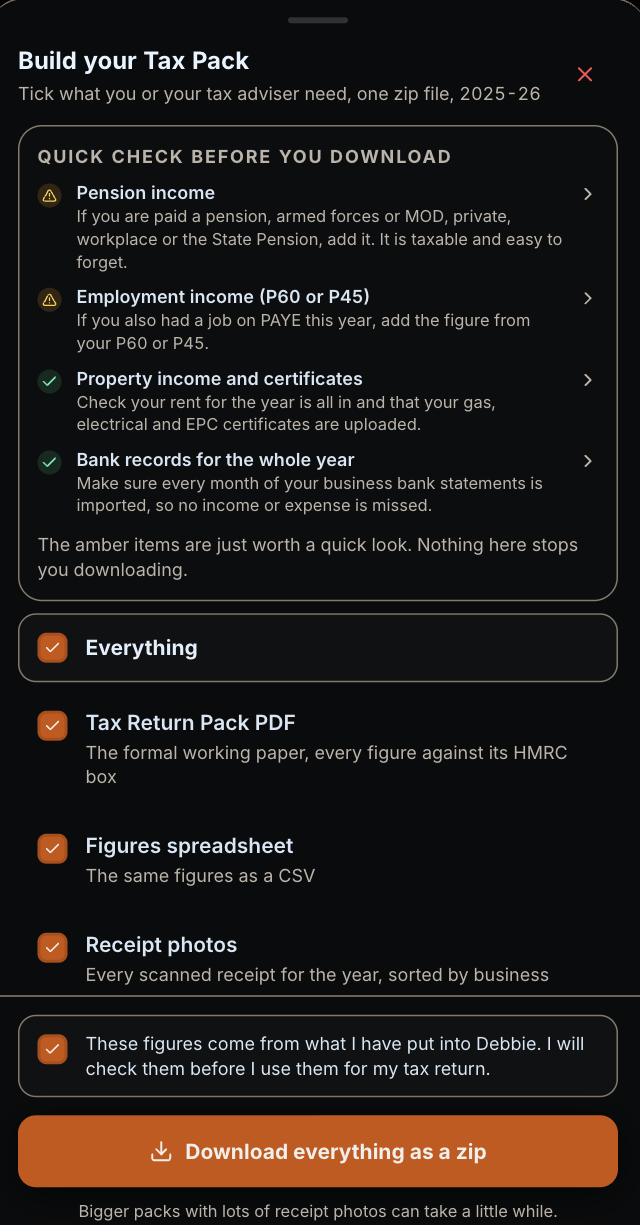
A real screen from the app. -
When you need it, Debbie sends your quarterly updates to HMRC for you, only after you check the figures and tap to confirm.
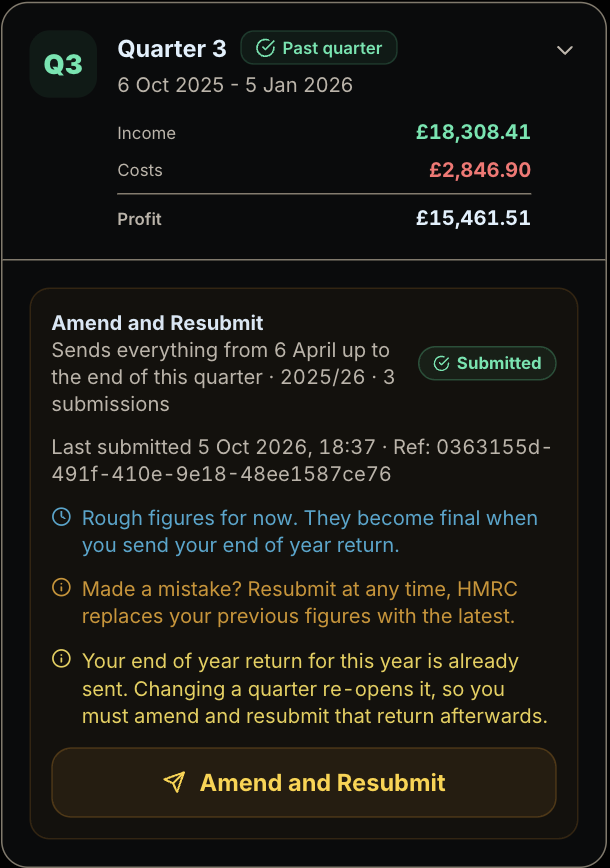
A real quarterly update screen from a test account, 2025/26 tax year.
Delivery driver tax questions
Do I pay tax on Amazon Flex?
Amazon Flex pays you as a self-employed delivery partner, so what you earn is trading income. If your trading income for the tax year (6 April to 5 April) is over £1,000, you need to tell HMRC and register for Self Assessment by 5 October after the end of that tax year. Your miles and costs come off before any tax is worked out. GOV.UK: income from online platforms and GOV.UK: register for Self Assessment.
I drive for three apps. Is that three businesses?
Usually not. Delivering for Uber Eats, Deliveroo, Just Eat and Amazon Flex is normally one trade, delivery driving, so it goes on one set of self-employment pages with one set of costs and one mileage claim. In Debbie that is one Solo business. The £1,000 trading allowance is also one allowance across all your trading income, not one per app. GOV.UK: tax-free allowances on trading income.
What is HMRC's mileage rate for 2026/27? Is it still 45p?
From 6 April 2026 a car or van claims 55p a mile for the first 10,000 business miles in the tax year, then 25p a mile after that. A motorcycle claims 24p a mile. Before 6 April 2026 the car and van rate was 45p, which is why you still see 45p quoted. GOV.UK: simplified expenses for vehicles.
Can I claim the miles from home to the depot?
No. HMRC does not allow travel between home and work, so the drive from home to the depot and back home again counts as commuting. The miles you drive from the depot on your round are business miles. That is why Debbie asks for your odometer when you leave the depot and again at your last drop. GOV.UK: travel expenses if you're self-employed.
Does 55p a mile come off my tax bill?
No, it comes off your profit. Each business mile lowers the profit you pay tax on by 55p. If you pay basic rate Income Tax at 20%, each mile is worth about 11p less Income Tax. GOV.UK: simplified expenses for vehicles and GOV.UK: Income Tax rates.
See every feature Debbie has, for drivers and everyone else, on the full feature list.
See the full feature list →Start your free month
Your first month is free, no card needed. Add a card only if you decide to stay.
Start your free monthHome · Driver tax calculator · MTD checker · All questions · Tax for creators