Tax for shops and sellers, worked out from your bank statement
Selling on Etsy, eBay, Amazon, Shopify or TikTok Shop? Running a market stall or a shop of your own? Payouts and card machine money land in your bank after fees, mixed in with everything else. Debbie reads your bank statement, finds your sales and the costs you can claim and shows roughly what you owe, so you can file your own tax return.
Self Assessment for shops in three steps
What you actually do in Debbie. Where we have a real screen from the app, it is shown.
-
1
Upload your bank statement
Export a statement from your banking app as a PDF, CSV, OFX or QIF and drop it into Debbie. It looks for payouts from Etsy, eBay, Amazon, Shopify and TikTok Shop, plus card reader payouts from SumUp, Zettle, Square and Stripe. It either books them as sales or asks you to confirm.
It treats a row as personal unless there is a reason to think it is business. It never quietly hides money in as personal, because leaving income out is the costly mistake.
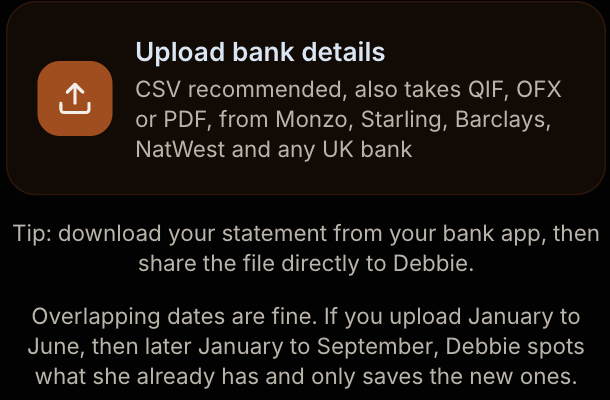
A real screen from the app. -
2
Add cash takings, one line per trading day
Take cash at a stall or over the counter? Cash never reaches your bank statement on its own, so add it in Debbie as one line for each day you trade, the total you took. Card payments already come in through your card reader payouts.
-
3
See roughly what you owe
Your sales, cash takings and costs come together as one profit figure, the figure you pay tax on, with your Income Tax and National Insurance estimate underneath. Download your Tax Return Pack to file it yourself or hand it to whoever files for you.
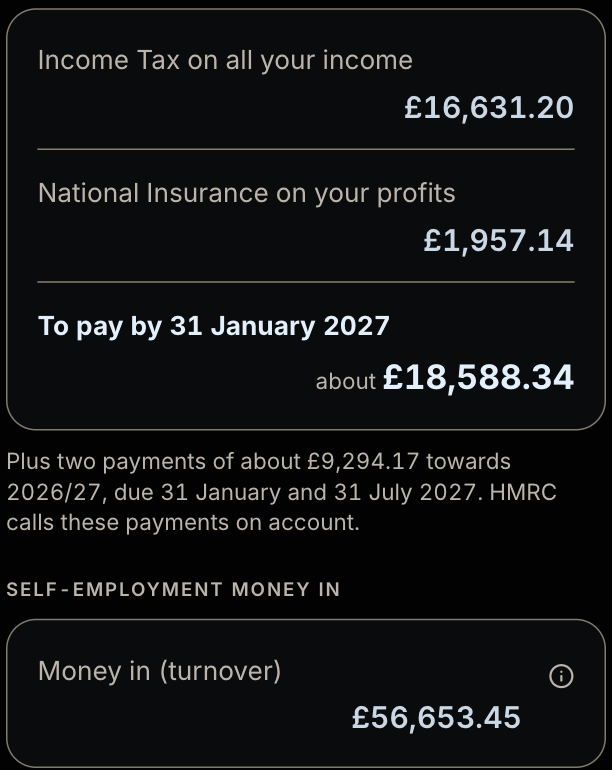
A real screen from a test account, 2025/26 tax year.
Etsy, eBay, Amazon, Shopify and TikTok Shop payouts
Platforms pay you after taking their fees, so a payout is less than what you sold. Fees charged to you separately, such as a Shopify plan or an eBay bill paid by card, come through as costs. Keep each platform's yearly sales report too, because the £1,000 trading allowance is measured on your sales before fees. GOV.UK: tax-free allowances on trading income.
Stock, packaging and postage
Stock you buy to sell, packaging and postage are business costs. Debbie leans towards cost for wholesalers such as Booker, Costco and Makro. Postage through Royal Mail, Evri or Parcel2Go counts as a cost too. Snap a receipt for anything bought with cash. Debbie keeps the money side straight, it does not count stock or run a till. GOV.UK: expenses if you're self-employed.
-
Snap a receipt in seconds
Bought stock or packaging with cash or a card Debbie cannot see? Take a photo of the receipt and Debbie reads the items for you. You check everything before it saves.
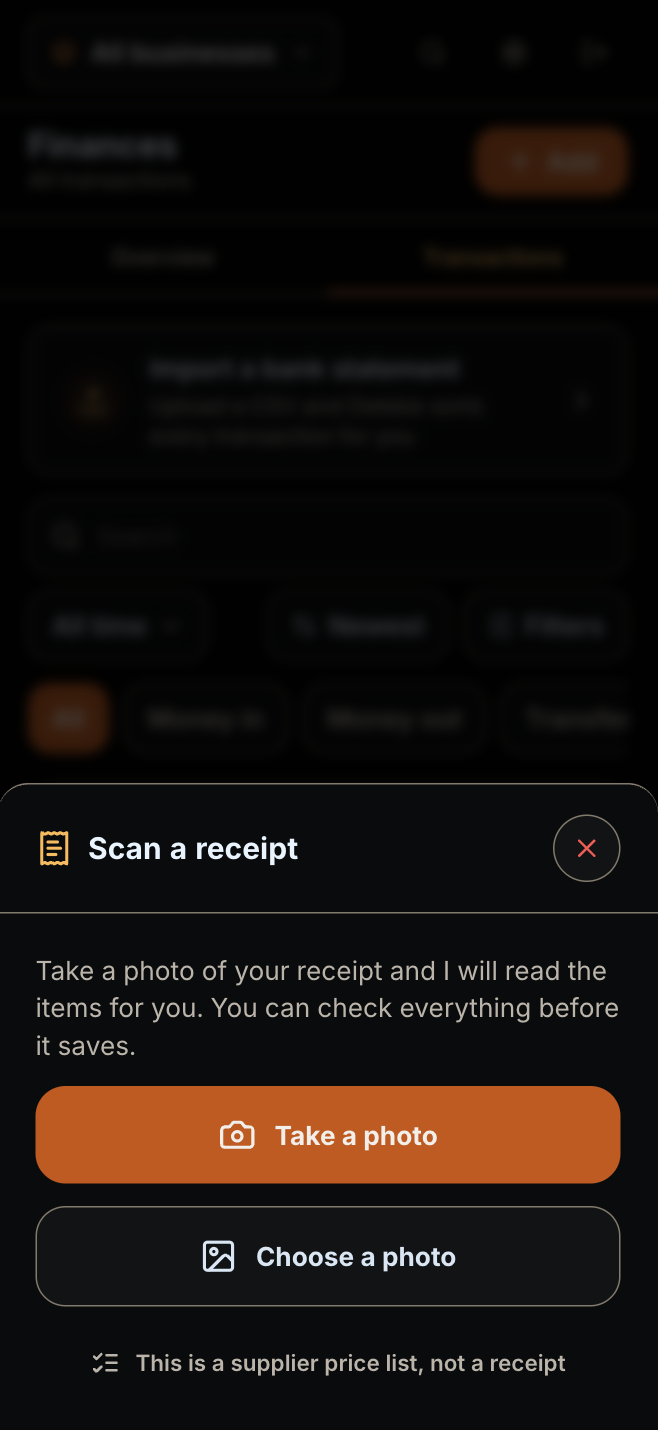
A real screen from the app.
Market pitches, card readers and shop rent
Pitch fees, market tolls, shop rent and business rates are business costs. Card reader payouts from SumUp, Zettle, Square or Stripe are your takings after the reader's fees. Cash you take out of the bank stays as money you drew for yourself unless you tell Debbie it paid for stock. GOV.UK: expenses if you're self-employed.
Platforms now tell HMRC what sellers made
Since 1 January 2024 selling platforms such as eBay, Etsy, Vinted and Amazon tell HMRC what their sellers made each calendar year. They send you a copy by 31 January.
It is not a new tax: selling your own unwanted things is usually not trading. A platform does not have to report you if you sold fewer than 30 items and were paid less than roughly £1,700 in the year.
Source: GOV.UK: income from online platforms.
The £1,000 trading allowance
If your sales for the tax year (6 April to 5 April) are £1,000 or less before costs, you usually do not need to tell HMRC. Over £1,000, you can take off either £1,000 or your real costs, whichever is bigger, not both. It is one allowance across all your trading, not one per platform. GOV.UK: tax-free allowances on trading income.
Just clearing out?
Selling your own unwanted things, such as old clothes or a pram, is usually not trading, so there is no Income Tax on it. It becomes trading when you buy things to sell on, make things to sell or sell regularly to make a profit. A single item that sells for £6,000 or more can bring in Capital Gains Tax. If you are only clearing out, you probably do not need Debbie. That is fine too. GOV.UK: income from online platforms and GOV.UK: Capital Gains Tax on personal possessions.
Packing orders at home?
-
Listing items, packing orders or doing the books at home all counts. HMRC's flat rate lets you claim a set amount a month for the hours you work there, no bills or receipts needed: £10 for 25 to 50 hours, £18 for 51 to 100 hours and £26 for 101 hours or more. Log your months in Debbie and it adds up the year. GOV.UK: simplified expenses for working from home.
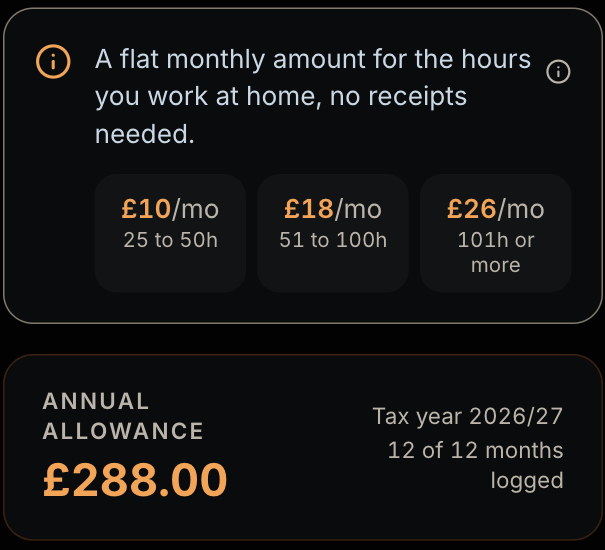
A real screen from the 2026/27 tax year.
Making Tax Digital? Most people do not need it yet
Making Tax Digital only starts once your self employment and property money in, added together before costs, is over £50,000 from April 2026, £30,000 from April 2027 and £20,000 from April 2028. GOV.UK: sign up for Making Tax Digital for Income Tax.
-
Until then, see your tax estimate and download your Tax Return Pack to file it yourself or have someone file it for you.
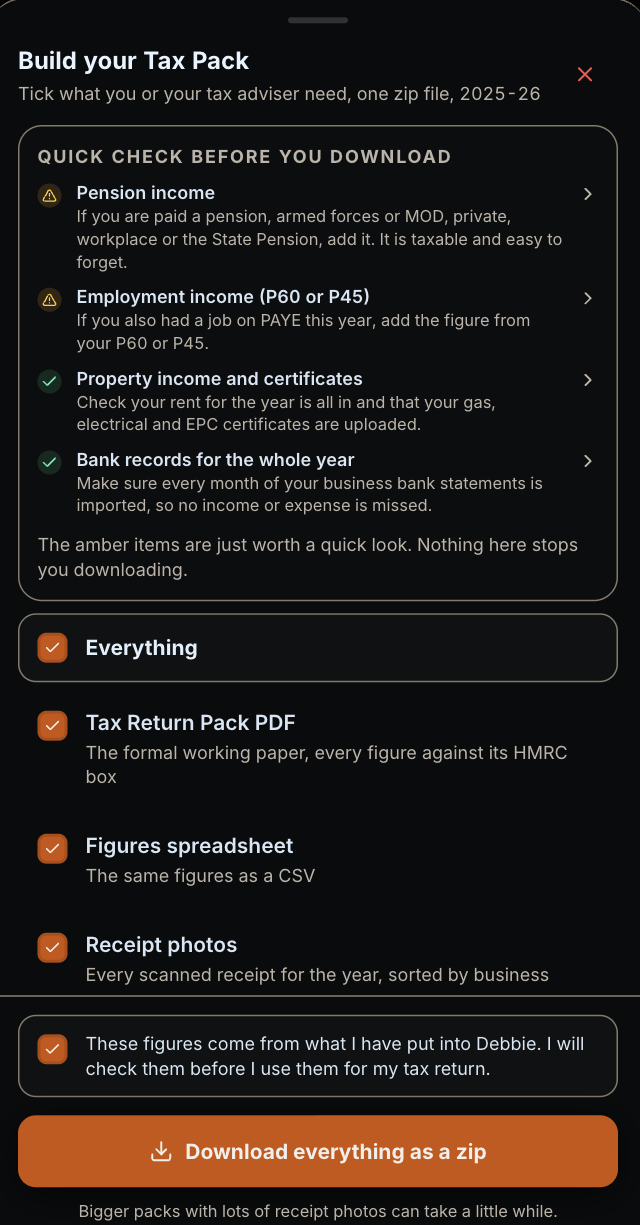
A real screen from the app. -
If it does apply, Debbie connects to HMRC and sends your quarterly updates for you, only after you check the figures and tap to confirm.
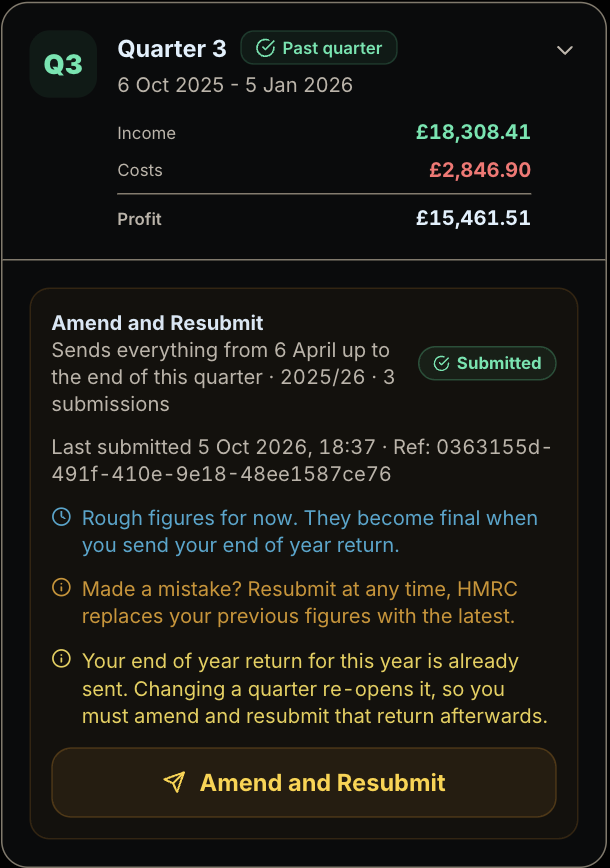
A real quarterly update screen from a test account, 2025/26 tax year.
Put tax aside each month
-
Debbie works out a monthly amount to put aside so your bill is covered by 31 January, including your first payment on account. Payments on account are advance payments towards next year's bill, due 31 January and 31 July. GOV.UK: payments on account.
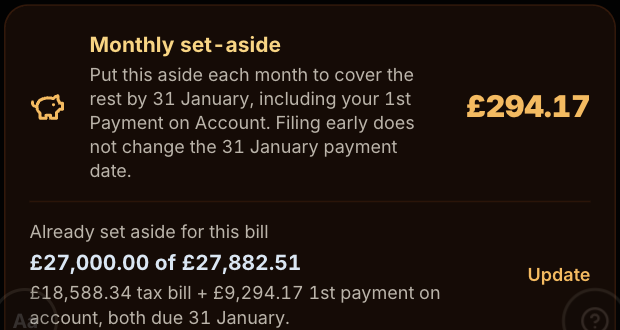
A real screen from a test account.
Shop and seller tax questions
Do I pay tax selling on Etsy or eBay?
If you make things to sell, buy things to sell on or sell regularly to make a profit, that is trading. If your trading income for the tax year (6 April to 5 April) is over £1,000 before costs, you need to tell HMRC. Selling your own unwanted things is usually not trading. GOV.UK: income from online platforms.
Will Etsy, eBay or Vinted tell HMRC about my sales?
Yes, since 1 January 2024 selling platforms tell HMRC what their sellers made each calendar year and send you a copy by 31 January. It is not a new tax. A platform does not have to report you if you sold fewer than 30 items and were paid less than roughly £1,700 in the year. GOV.UK: income from online platforms.
Is the £1,000 trading allowance per platform?
No. It is one £1,000 allowance across all your trading income, so Etsy, eBay, a market stall and any other side work are added together. It is measured on sales before fees and costs. You either take the £1,000 or claim your real costs, not both. GOV.UK: tax-free allowances on trading income.
Can I claim stock, packaging and postage?
Yes. Stock you buy to sell, packaging, postage, pitch fees, shop rent and business rates are allowable business costs. Anything you buy for yourself stays personal. GOV.UK: expenses if you're self-employed.
When do I need to register for Self Assessment?
By 5 October after the end of the tax year you started. So if your sales went over £1,000 in the tax year ending 5 April 2026, you register by 5 October 2026. GOV.UK: register for Self Assessment.
See every feature Debbie has, for shops and everyone else, on the full feature list.
See the full feature list →Start your free month
Your first month is free, no card needed. Add a card only if you decide to stay.
Start your free month